Introduction
Murraya konigii (Curry leaves), the other potent Ayurvedic herb in our formulation, offers numerous benefits for diabetes and other metabolic disorders. Scientific studies have demonstrated its hypoglycemic effects, promoting hepatic glycogenesis and inhibiting glycogenolysis and gluconeogenesis. Additionally, it exhibits antioxidant and anti-inflammatory properties, further supporting overall health (Bhupatiraju et al., 2023; Abeysinghe et al., 2021; Husna et al., 2018 ). By harnessing the power of Curry leaves, our supplement aims to provide a natural and practical approach to diabetes management, helping individuals maintain a balanced lifestyle with improved glucose metabolism and reduced risk of related complications, as shown in Figure 1a. Our study aimed to harness the scientific evidence supporting the use of these two Ayurvedic herbs to create polyherbal anti-diabetes cookies, offering a natural and potentially effective approach to managing diabetes and related complications. Despite the individual benefits of guar gum and curry leaves, there is limited research on their combined effects in a food matrix, particularly in the form of fiber-enriched cookies. In this research, we will develop cookies incorporating different levels of guar gum flour and curry leaves powder to create a functional food product and will determine the nutritional composition of formulated cookies. Invitro starch hydrolysis rate and glycemic index of the cookies will be evaluated to determine their potential impact on the blood glucose level and health benefits in diabetes management. This study aims to address this gap by formulating cookies with varying levels of guar gum flour and assessing their nutritional composition and potential benefits for diabetes management.
Cyamopsis tetragonoloba (Guar Gum), one of the Ayurvedic herbs in our supplement, plays a pivotal role in diabetes management. Its non-absorbable carbohydrate properties delay stomach emptying and slow nutrient absorption, aiding in better glycemic control. Guar Gum’s gel-forming ability further regulates carbohydrate and lipid metabolism, improving insulin sensitivity and reducing hyperlipidemia (Sadhukhan et al., 1994; Holt et al., 1979; Gassull et al., 1979; Jenkins et al., 1978). Its inclusion in the supplement aims to enhance blood glucose levels and support cardiovascular health.
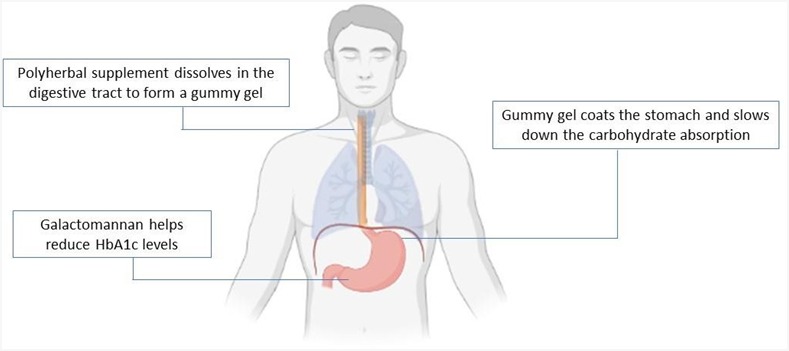
Fig.1a Impact of Ayurvedic Herbs in Polyherbal Anti-Diabetes Cookies on Glucose Metabolism and Related Complications.
Murraya konigii (Curry leaves), the other potent Ayurvedic herb in our formulation, offers numerous benefits for diabetes and other metabolic disorders. Scientific studies have demonstrated its hypoglycemic effects, promoting hepatic glycogenesis and inhibiting glycogenolysis and gluconeogenesis. Additionally, it exhibits antioxidant and anti-inflammatory properties, further supporting overall health (Bhupatiraju et al., 2023; Abeysinghe et al., 2021; Husna et al., 2018 ). By harnessing the power of Curry leaves, our supplement aims to provide a natural and practical approach to diabetes management, helping individuals maintain a balanced lifestyle with improved glucose metabolism and reduced risk of related complications, as shown in Figure 1a. Our study aimed to harness the scientific evidence supporting the use of these two Ayurvedic herbs to create polyherbal anti-diabetes cookies, offering a natural and potentially effective approach to managing diabetes and related complications. Despite the individual benefits of guar gum and curry leaves, there is limited research on their combined effects in a food matrix, particularly in the form of fiber-enriched cookies. In this research, we will develop cookies incorporating different levels of guar gum flour and curry leaves powder to create a functional food product and will determine the nutritional composition of formulated cookies. Invitro starch hydrolysis rate and glycemic index of the cookies will be evaluated to determine their potential impact on the blood glucose level and health benefits in diabetes management. This study aims to address this gap by formulating cookies with varying levels of guar gum flour and assessing their nutritional composition and potential benefits for diabetes management.
Statistical Analysis
The statistical analyses were performed using GraphPad prism 8.0.2 The data obtained from the various analyses were statistically analyzed using one-way analysis of variance (ANOVA) followed by Turkey’s multiple comparison test to determine significant differences between the means. The results were expressed as a p-value of <0.05 was considered statistically significant.
Result And Discussion
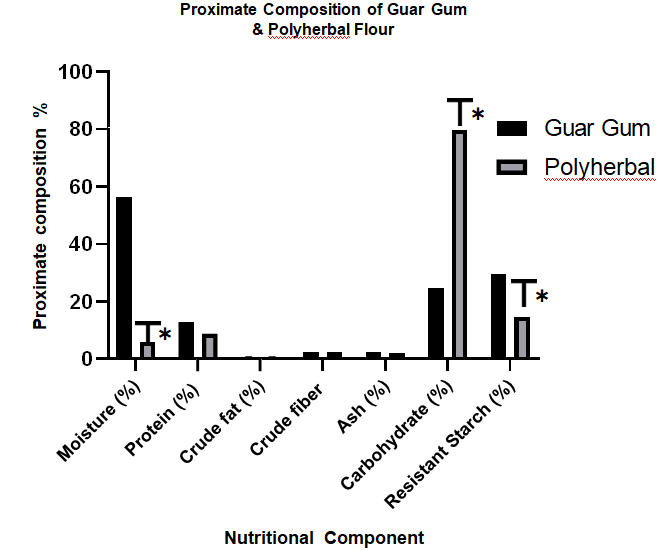
Proximate Analysis: Table 2 presents the proximate composition of guar gum and cookies, showing a significant reduction (p < 05) in protein and ash content after processing the polyherbal cookies into flour. There was a significant increase (p < 0.05) in the proportion of moisture, crude fiber, ash and moisture content. In contrast, the proportion of crude fat and carbohydrate decreased significantly (p < 0.05) Figure 2. The amount of water content in the cookie was directly proportional to the increase in guar gum substitution. Non-wheat flour contributed to this phenomenon due to its higher water absorption capacity than wheat flour. Additionally, the higher fiber content in non-wheat flour played a crucial role in water binding through its hydroxyl groups, as Wang et al. (2002) indicated. Water content was crucial in determining the cookies’ final quality by affecting starch’s gelatinization.
The comparison of the mean of guar gum and polyherbal samples for each nutritional component. *p< 0.001 indicates the standard deviation (SD) of the mean and significance levels annotated with asterisks.
Resistant Starch Content
As shown in Table 3, the polyherbal RS content was found to be significantly lower (p < 0.05) compared to raw guar gum. However, as the substitution level of polyherbal cookie flour increased, the RS content in the samples also increased significantly (p < 0.05) as shown in Figure 2. The RS content in 10% guar gum cookies increased by 16.3% compared to the control guar gum, while the RS content in 20% and 30% polyherbal cookies samples nearly doubled compared to the control as in Table 4. The process of making cookies involves heat treatment followed by cooling, which leads to the formation of retrograded starch (RS3) due to increased gelatinized starch. Repeated heating and cooling processes during cookie-making resulted in higher RS content in the polyherbal samples (Niba, 2003). RS formation is associated with the retrogradation of starch, especially amylose molecules, leading to enzyme-resistant amylose-amylose linkages (Onyango et al., 2005). 01952 Amylopectin also plays a significant role in RS formation in polyherbal cookies, where linear molecules of amylopectin may participate in starch retrogradation, thus increasing RS content in the samples (Åkerberg, Liljeberg, & Björck, 1998). Apart from amylose/amylopectin concentration, other factors like the presence of other food components and the type of processing applied also contribute to the RS content of food products (Rosin, Lajolo, & Menezes, 2002). High molecular Weight (HMW) maltodextrin molecules can be reassociated with starch molecules to form double helices, leading to increased RS content at low concentrations of maltodextrin (Wang & Jane, 1994). Additionally, the amount of dietary fiber and moisture content also influences the extent of RS formation by promoting the degree of starch gelatinization (Tas & El, 2000).
In Vitro Starch Hydrolysis
The kinetics of in vitro starch hydrolysis for polyherbal cookies with varying levels of guar gum and the addition of maltodextrin and α-amylase are summarized in Table 5. At higher guar gum substitution levels, there was a significant decrease (p < 0.05) in starch hydrolysis, with 30% guar gum showing the lowest hydrolysis rate. The in vitro starch hydrolysis for 0%, 10%, 20%, and 30% guar gums was significantly reduced (p < 0.05) by 6.5%, 9.5%, 11.0%, and 22.6%, respectively, compared to the control. The study also observed a decreased hydrolysis index and estimated glycemic index with higher guar gum substitution, indicating potential benefits for glycemic control.
The glycemic effects of food are influenced by various factors, including food texture, particle size, type of starch (amylose: amylopectin ratio), physical entrapment of starch within the food, food processing, and other ingredients like sugars, fat, protein, dietary fiber, and antinutrient content. Foods with higher resistant starch (RS) content have been associated with lower glycemic and insulinemic responses in healthy individuals. Studies have reported that products rich in RS potentially benefit blood glucose management (Åkerberg, Liljeberg, & Björck, 1998; Behall & Schofield, 2005).
The results indicate an inverse relationship between the resistant starch (RS) content and 6 hydrolysis index (HI) value in Guar gum samples with higher substitution levels (y = -1.936x + 46.565); (R2 = 0.9702) Figure. 3. The graph shows that as the hydrolysis index increases, the resistance starch content also increases significantly. The slight negative slope of the calculated HI trend line suggests that as the HI increases, there is a minor decrease in the calculated HI value (El, 1999; Åkerberg et al., 1998; Goñi & Valentín-Gumazo, 2003; Behall & Schofield, 2005; Yamada et al., 2005; Rosin et al., 2002). The high R-square value (0.9702) of the linear regression line indicates that the variation in the calculated HI Detailed statistical data, including raw data, p- p-values, and confidence intervals.
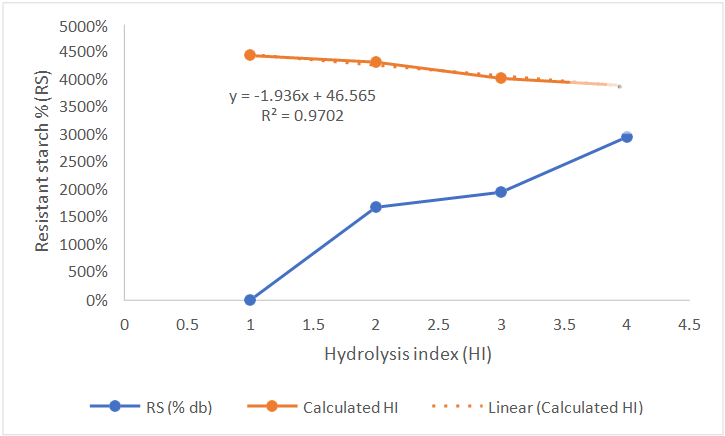
Fig.3. The relationship between resistant starch (RS) content and hydrolysis index (HI) value in polyherbal cookies
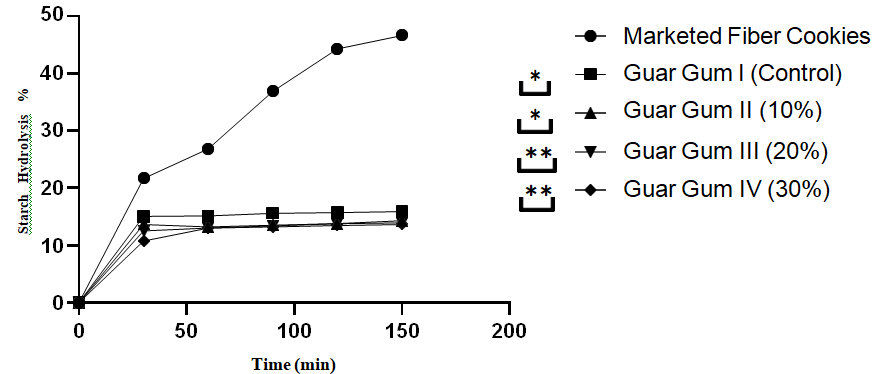
Fig. 4: In vitro starch hydrolysis (%) profile of marketed fiber cookies (reference) and polyherbal cookies with varying levels of guar gum substitution combined with maltodextrin and a-amylase. The (*P< 0.05, **P< 0.01) indicating significant difference between specific treatments.
Conclusion
The study successfully developed fiber-enriched cookies incorporating guar gum and curry leaves, providing a functional food product with potential benefits for diabetes management. The cookies were well accepted by the sensory panelists, and their nutritional composition showed higher protein and fiber-enriched cookies had a lower glycemic response, making them suitable for diabetic individuals. These fiber-enriched cookies can be incorporated into a diabetic diet as a healthier snack alternative. Due to their low glycemic index and high fiber content, they can help maintain stable food glucose levels. Diabetic individuals can consume these cookies as part of mild morning or afternoon snacks, helping them manage hunger pangs without causing significant spikes in blood glucose levels. Moreover, the presence of bioactive compounds in curry leaves can provide additional health benefits, such as improved insulin sensitivity and antioxidant effects.
While the study provides promising results, it has some limitations. The in vitro methods used to assess starch hydrolysis and glycemic index may not fully replicate the complex processes of human digestion and metabolism. Additionally, the sensory evaluation was conducted on a small scale, and large, more diverse panels may be needed for a comprehensive understanding of consumer acceptance. The study did not evaluate the long-term effects of consuming these cookies on blood glucose levels in diabetic individuals. Future studies should focus on clinical trials to validate the efficacy of these cookies in managing blood glucose levels in diabetic patients over a more extended period. Research should also explore the potential benefits of incorporating other hypoglycemic herbs and varying the proportions of ingredients to enhance the cookie’s nutritional profile further. Additionally, investigating the cookie’s effect on other health makers, such as lipid profiles and inflammatory markers, could provide a more comprehensive understanding of their health benefits.
References
- Abeysinghe, D. T., Alwis, D. D. D. H., Kumara, K. A. H., & Chandrika, U. G. (2021). Nutritive Importance and Therapeutics Uses of Three Different Varieties (Murraya koenigii, Micromelumminutum, and Clausena indica) of Curry Leaves: An Updated Evidence-Based Complementary and Alternative Medicine, 2021, 5523252. https://doi.org/10.1155/2021/5523252
- Bhupatiraju, L., Bethala, K., Wen Goh, K., Singh Dhaliwal, J., Ching Siang, T., Menon, , Menon, B., Anchu, K. B., Yee Chan, S., Chiau Ming, L., & Khan, A. (2023). Influence of Murraya koenigii extract on diabetes induced rat brain aging. Journal of Medical Life, 16(2), 307-316. https://doi.org/10.25122/jml-2022-0151
- Bonetti, G., Herbst, K. L., Donato, K., Dhuli, K., Kiani, A. K., Aquilanti, B., Velluti, V., Matera, , Iaconelli, A., & Bertelli, M. (2022). Dietary supplements for obesity. Journal of Preventive Medicine and Hygiene, 63(2 Suppl 3), E160-E168. https://doi.org/10.15167/2421-
- Derosa, G., D’Angelo, A., & Maffioli, P. (2022). The role of selected nutraceuticals in the management of prediabetes and diabetes: An updated review of the Phytotherapy Research, 36(10), 3709-3765. https://doi.org/10.1002/ptr.7564
- El-Hawary, S. S., Tadros, S. H., AbdelMohsen, M. M., Mohamed, M. S., El Sheikh, E., Nazif, N. M., & ElNasr, M. S. (2020). Phyto- and Bio-Chemical evaluation of Diospyros kaki cultivated in Egypt and its biological activities. Brazilian Journal of Biology, 80(2), 295-304. https://doi.org/10.1590/1519-6984.200460
- Francisco, M., Velasco, P., Moreno, D. A., García-Viguera, C., & Cartea, M. E. (2010). Cooking methods of Brassica rapa affect the preservation of glucosinolates, phenolics, and vitamin Food Research International, 43(5), 1455–1463. https://doi.org/10.1016/j.foodres.2010.04.024
- Gassull, M. A., Goff, D. V., Haisman, P., Hockaday, T. D., Jenkins, D. J., Jones, K., … & Wolever, M. (1976). Proceedings: The effect of unavailable carbohydrate gelling agents in reducing the post-prandial glycaemia in normal volunteers and diabetics. The Journal of Physiology, 259(1), 52P-53P.
- Goñi, I., Garcia-Alonso, A., & Saura-Calixto, F. (1997). A starch hydrolysis procedure to estimate glycemic Nutrition Research, 17(3), 427-437.
- Goñi, , Garcia-Diz, L., Mañas, E., & Saura-Calixto, F. (1996). Analysis of resistant starch: a method for foods and food products. Food Chemistry, 56(4), 445-449.
- Gregory, G. A., Robinson, T. I. G., Linklater, S. E., Wang, F., Colagiuri, S., de Beaufort, , Donaghue, K. C., … Ogle, G. D. (2022). Global incidence, prevalence, and mortality of type 1 diabetes in 2021 with projection to 2040: A modeling study. Lancet Diabetes & Endocrinology, 10(10), 741-760. https://doi.org/10.1016/S2213-8587(22)00218-2
- Holt, S., Carter, D., Tothill, P., Heading, R., & Prescott, L. (1979). Effect of gel fiber on gastric emptying and absorption of glucose and The Lancet, 313(8117), 636- 639.
- Husna, F., Suyatna, F. D., Arozal, W., &Poerwaningsih, E. H. (2018). Anti-Diabetic Potential of Murraya Koenigii (L.) and its Antioxidant Capacity in Nicotinamide- Streptozotocin Induced Diabetic Drug Research (Stuttgart), 68(11), 631-636. https://doi.org/10.1055/a-0620-8210
- Jenkins, D. J., Wolever, T. M., Leeds, A. R., Gassull, M. A., Haisman, P., Dilawari, J., … & Alberti, K. G. (1978). Dietary fibers, fiber analogs, and glucose tolerance: Importance of British Medical Journal, 1(6124), 1392-1394.
- Mudgil, , Barak, S., &Khatkar, B. S. (2014). Guar gum: Processing, properties and food applications – A Review. Journal of Food Science and Technology, 51(3), 409-418. https://doi.org/10.1007/s13197-011-0522-x
- Walther, , Guggisberg, D., Badertscher, R., Egger, L., Portmann, R., Dubois, S., Haldimann, M., Kopf-Bolanz, K., Rhyn, P., Zoller, O., Veraguth, R., & Rezzi, S. (2022). Comparison of nutritional composition between plant-based drinks and cow’s milk. Frontiers in Nutrition, 9, 988707. https://doi.org/10.3389/fnut.2022.988707